





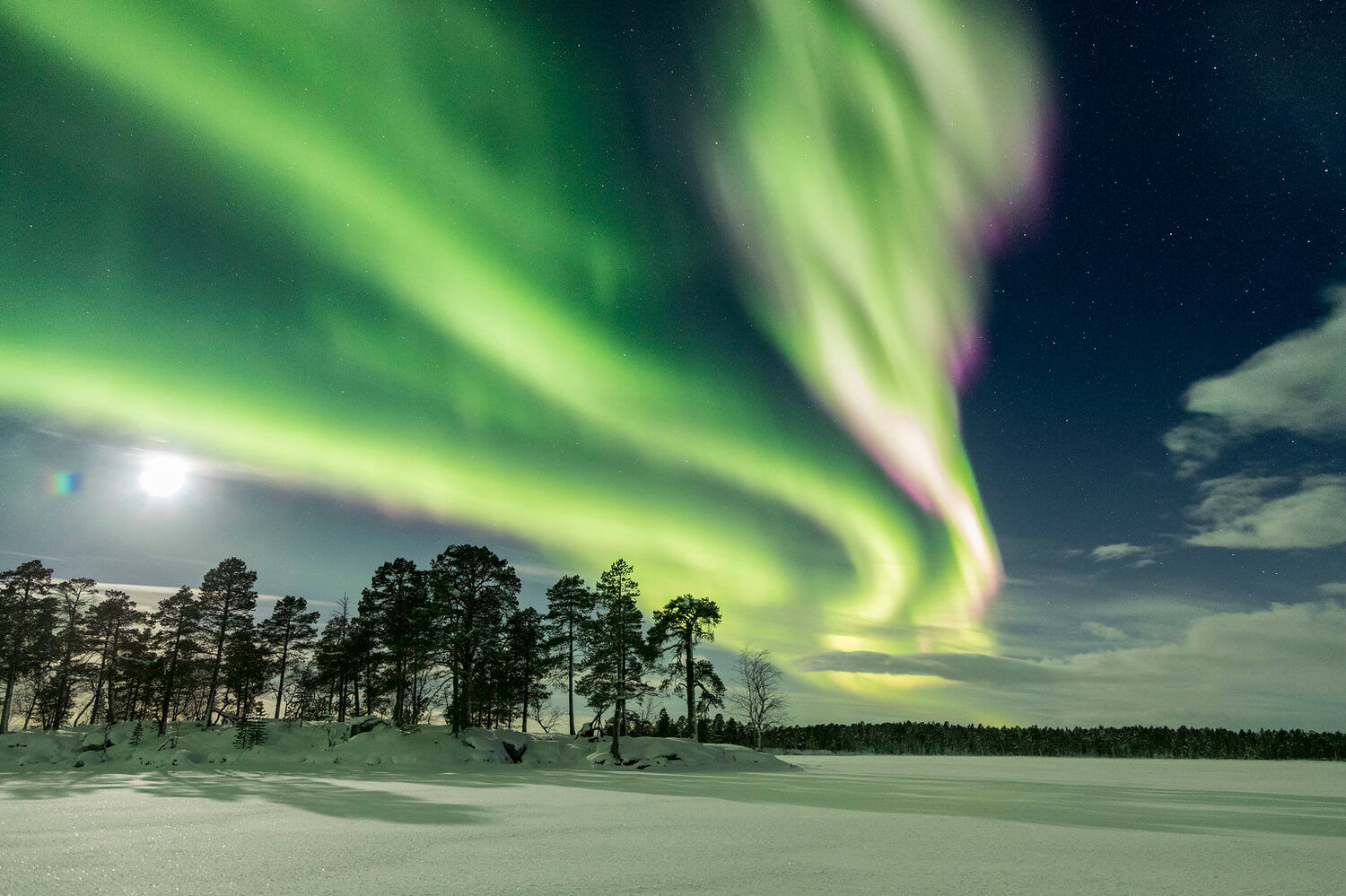

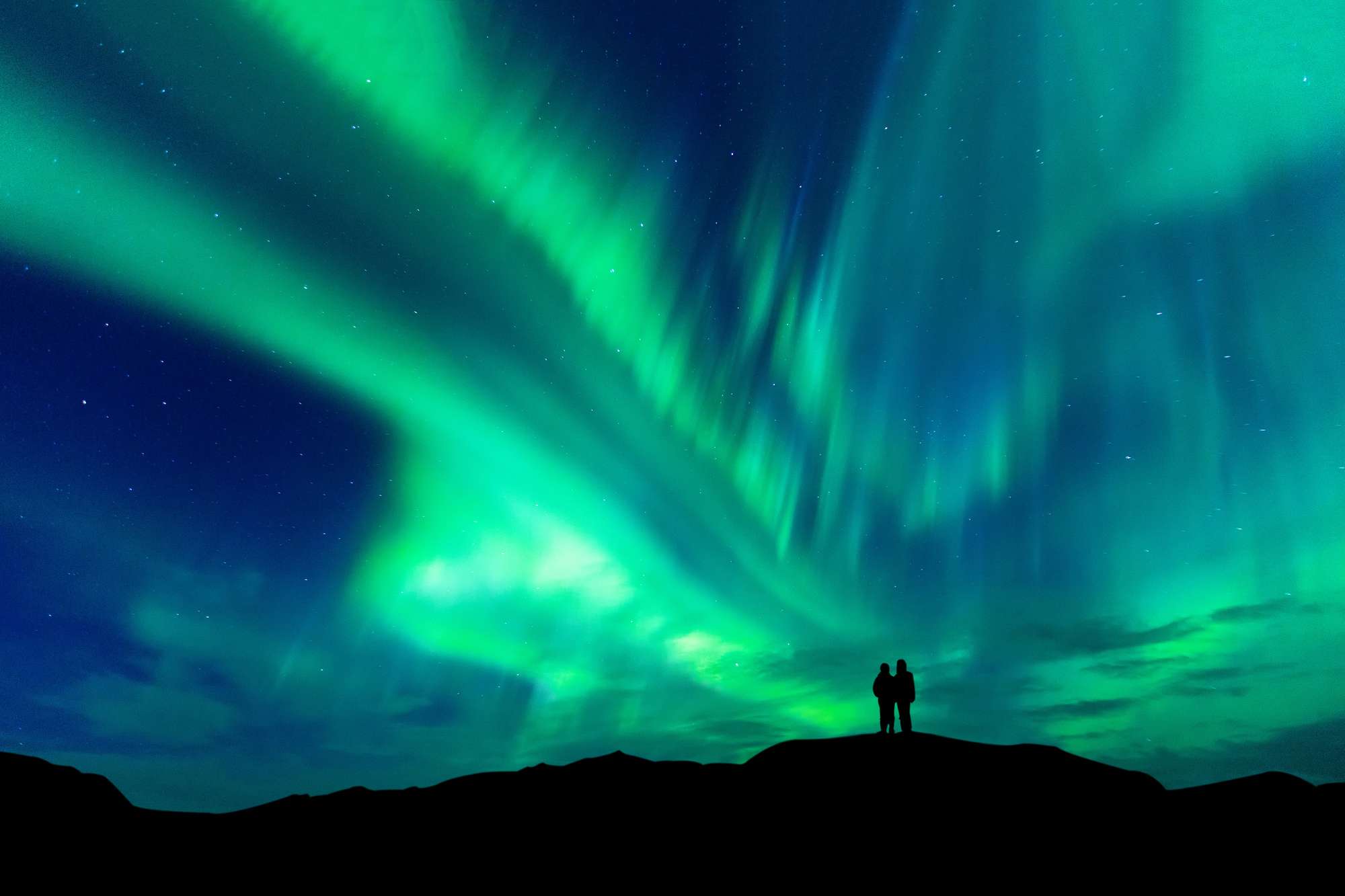









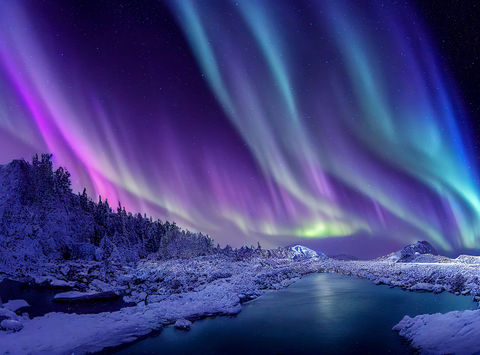
Mystery and wonder shroud the northern lights, otherwise known as the aurora borealis. Mesmerising, stunning, other-worldly are just a few words used to describe the experience of watching this spectacular phenomenon. When conditions are favourable fantastical displays light up the Arctic and sub-Arctic skies, leaving all who catch a glimpse of the aurora transfixed and with memories that will last forever.
Displays of the northern lights vary in intensity and duration, and with shape and form seemingly having no regulation, each sighting feels unique. This natural phenomenon is hard to predict, yet extraordinary to witness!
Seeing the aurora is one of the main motivations for travellers visiting northern latitudes during the frigid winter months – drawn like moths to a flame. But what did early cultures make of these celestial lights? In Greek and Roman mythology the lights signalled the start of a new day. Whereas Cree Indians, a North American tribe, believed that the lights were the spirits of departed loved ones trying to communicate with those they’d left behind. Delving into the legends, myths and the science surrounding the northern lights is fascinating stuff. And it might also make you a better aurora hunter!
Magic or morbid
Before scientists started to puzzle over the literal cause of these magical lights, myths and legends dominated the theories. Over the centuries, there have been many different interpretations of the aurora from those that witnessed them. Some portents of good fortune, others, messages from the heavens.
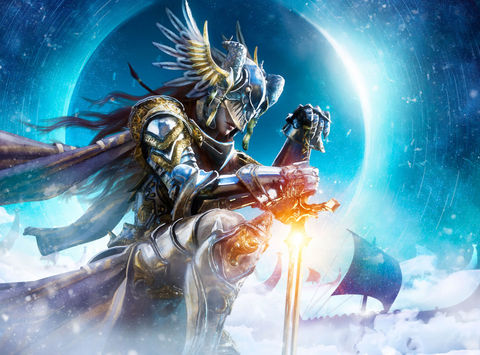
The old Norse explanation was that the strange, shimmering green lights were old maids dancing in the heavens. Icelandic myths linked the aurora to spirits of the dead. Vikings believed the glowing lights were reflections from the shields of the Valkyries, maidens who transported fallen warriors to Valhalla.
Scandinavian fisherman called the sightings Herring Flash as they saw them as a sign of rich catches, believing them to be caused by light reflecting off vast shoals of lively herring. Farmers saw psychedelic fields of swaying crops.
In Finland, according to legend, when the fox runs across the snowy Arctic fells it lights up the night sky with sparks flying from its tail. The Finnish word for the northern lights ‘revontulet’ literally means ‘fire fox’.
In Siberia they believed children born under the aurora lived a long and prosperous life and early Chinese legends associated the aurora with fire-breathing dragons.
Modern day myths exist too – the Japanese believe that babies conceived under the northern lights will become intellectuals.
Inuit fears and… football!
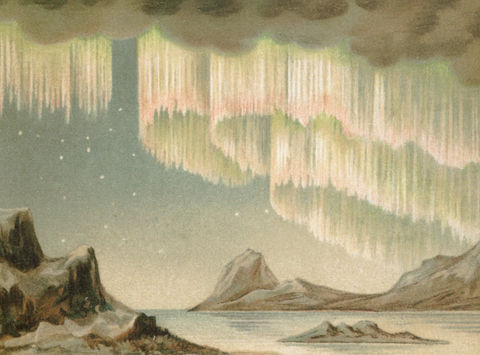
Certain Inuit people used to live in fear of the lights – terrified that the spikes of bright green and crimson were evil spirits intent on a frenzy of beheading. Some Northern American Inuit call the aurora ‘aqsarniit’ (literally ‘football players’) because they believe that the lights are ancestral spirits kicking around the head of a walrus.
At the very least, you should never wave, sing or whistle at the northern lights – many cultures believed this would lure body-snatching demons down from the skies.
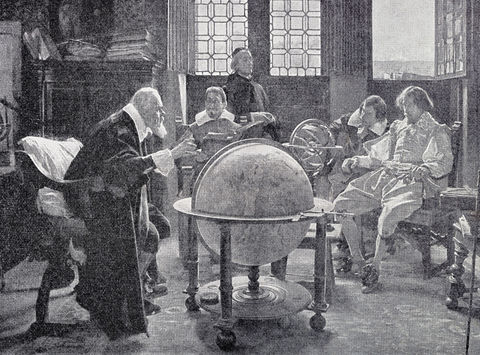
Galileo coined the phrase ‘aurora’
Galileo Gallilee witnessed the northern lights in 1621 and coined the phrase aurora borealis (aurora for goddess of the dawn, borealis for the Greek god of the north wind). He thought it was caused by sunlight reflecting off the Earth’s atmosphere. About a century later, British astronomer Edmund Halley thought that the lights were caused by luminous material seeping from cracks in the earth’s crust.
Even in the late nineteenth century, polar explorers like Nansen and Amundsen were more likely to wax lyrical about the aurora than provide any kind of scientific explanation. It wasn’t until 1908 that the Norwegian Kristian Birkeland proposed the first accurate theory – and amazingly, this was only proven in 1967 when a US satellite recorded strange disturbances each time it passed over the poles.
So, what is happening up there?
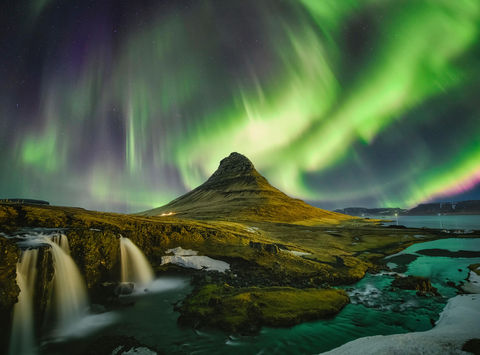
What causes the northern lights?
It all starts with the sun – that huge energy and light-producing ball of glowing gases. Immense pressure and temperatures of 27 million degrees Fahrenheit in the sun’s core fuel the process of nuclear fusion. The energy generated by this creates large bubbles of hot plasma – a soup of intensely charged particles. These swell and circulate, so full of unrestrained energy, that every now and then they erupt from the sun’s surface. A Coronal Mass Ejection! Flung into space at speeds of 1,000km per second, this super-charged plasma hurtles through space.
Luckily for us, we have our trusty magnetic field. If Earth lies in the path of this deadly solar wind (which usually takes 2-4 days to reach us), most of the plasma is deflected back into space.
But enough supercharged electrons and protons sneak into our upper atmosphere (particularly at the poles where magnetic fields are weaker) and start colliding with oxygen, nitrogen and hydrogen.
Following a collision, these elements store some of the energy or become ‘excited’. And the only way they can return to a stable state is by releasing photons. Or, in other words, producing light.
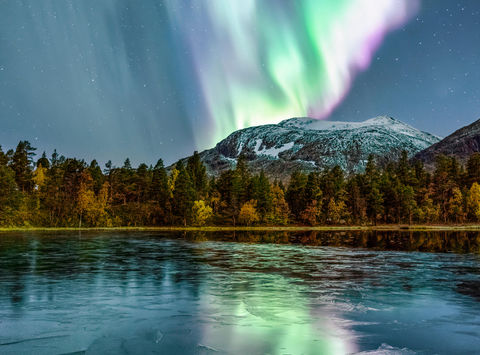
Here’s a few takeaways about the aurora borealis…
They usually occur between 60- and 75-degrees latitude making Iceland, Norway, Sweden, Finland, Canada and Alaska excellent locations for seeing the aurora.
They can reliably be seen from late August to mid-April when the skies are dark enough in the above region.
Strong aurora reach lower latitudes such as the UK and can be seen (though typically only through a lens) even in summer.
They are more active around the equinoxes.
They are not impacted by lunar activity.
They can be seen by the naked eye.
The northern and southern lights (aurora australis) occur simultaneously.
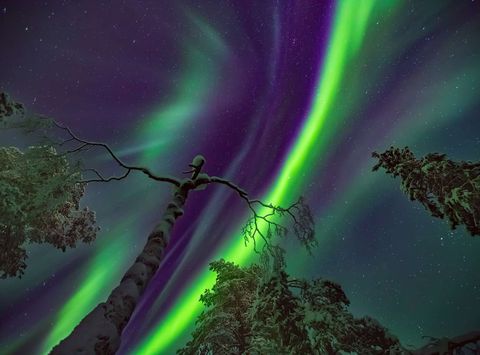
The expert view
Plasma physicist and aurora enthusiast, Melanie Windridge, knows her stuff when it comes to the northern lights. With so much information available to the casual aurora hunter, we asked her for one fact about the phenomenon that still blows her mind. She answered with the following.
“The aurora is a protective mechanism important for the survival of life on Earth. It is a way that the Earth gets rid of excess energy that hits us from the Sun. As well as light, the Sun emits a stream of charged particles called the ‘solar wind’, which is mostly protons and electrons. When the solar wind reaches Earth it butts up against our magnetic field – our protective shield – and pumps it so full of energy that electrons caught up in the field around the back of the Earth are accelerated into our atmosphere, which glows with auroral light. If Earth didn’t have a magnetic field we wouldn’t see the aurora, but we probably wouldn’t have an atmosphere either, as it would have been stripped away by the solar wind, just like the atmosphere of Mars has been.”

Facts are fine, but fortune plays a part…
Not many of us are lucky enough to simply step into the garden to witness a vivid display of the aurora. But that has happened around the UK on several occasions in the last few years with incredible photographs shared in the media. Sightings of the northern lights are not commonplace at these latitudes, but several intense solar storms that have come out of Solar Cycle #25 serve as a reminder of how this celestial phenomenon is both unpredictable, and yet truly captivating.
In nearly all cases with low latitude aurora, the colours were only visible through photography. It’s one thing to see the northern lights from behind a camera. But to witness them shimmer and dance with the naked eye is another.
Putting yourself in prime locations within the auroral oval is the best way to achieve aurora hunting success. It’s not a guarantee though. Space weather scientists predict the likelihood of the aurora based on behaviours of the sun, producing 27-day and 3-day modelling, much like terrestrial weather forecasts. Even when the KP index (the scale for measuring geomagnetic activity) is high it doesn’t mean they will appear. And if they do, the meteorological gods may yet interfere. Cloud cover can the biggest killjoy for aurora hunters. But it’s this elusive behaviour that makes seeing the northern lights such a treat. When you visit the far north between September and early April, the prospect is almost as sweet as the vision itself… almost.

A place in the country
Location should be a major consideration when selecting a northern lights holiday. And that goes beyond picking a country. Don’t be lured by cheap offers of weekend breaks in Reykjavik, which include an evening excursion to ‘see the lights’. You want to be outside of built-up areas and light pollution, not just for a few hours, but the for the duration of your holiday.
Our top locations include the Aurora Sky Station at Abisko in Swedish Lapland, Hotel Ranga in Iceland’s southern countryside and just outside Tromso in northern Norway. Many of the hotels we use offer a wake-up service if the lights make an appearance during the night, and the more remote you are the more spectacular the show will be!
Always remember… be patient and don’t expect too much too soon. It’s a natural, unpredictable phenomenon that is worth the wait, and perhaps, return journeys! Each time is different.
Plan your northern lights adventure
We’ve a wide collection of northern lights holidays designed to optimise your viewing potential. Browse the collection, chat to one of our dedicated Travel Specialists on 01737 214 250 or send an enquiry and start planning.